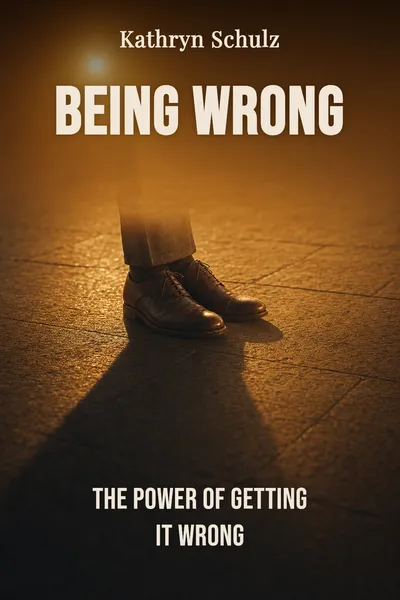
Being Wrong
The power of getting it wrong
Description
There is a specific, almost comic moment that Kathryn Schulz keeps returning to in her 2010 book Being Wrong: the instant you realize you've been mistaken about something you were sure of. Not a small slip — a real one. You've argued the point, staked your credibility on it, felt the warm certainty of being right. And then the ground shifts. The friend you swore you saw across the street was a stranger. The password you typed with total confidence was wrong. The person you were certain had wronged you had done nothing of the kind. Schulz, a journalist who spent years reporting on the subject, noticed something odd about these moments: we describe them constantly, yet we almost never study them.
That gap is her starting point. We have a rich vocabulary for other people's errors and almost none for our own. Being wrong, from the inside, feels like nothing at all — it feels exactly like being right, up until the second it collapses. Schulz calls this the strange interior of error, and she spends the book pulling apart why a species as clever as ours is so bad at noticing when it has gone astray, and why we treat the discovery as a kind of humiliation rather than the ordinary weather of a thinking mind.
What makes the book more than a catalogue of mistakes is where Schulz takes the argument. She's less interested in cataloguing how we err than in what our horror of erring costs us — in our relationships, our politics, our capacity to change our minds at all. She wants to rehabilitate a state we've been taught to dread, and to ask what we'd gain by making peace with it.
The question we’re asking : Why does being wrong feel like nothing until it suddenly feels like everything, and what does our fear of it cost us?What we’ll see : How a curious, well-read guide takes error apart — the feeling, the wiring, the stories we tell — and lands somewhere unexpectedly warm.
Table of contents
01Chapter 1 — The feeling that never arrives
Schulz opens with a deceptively simple puzzle. What does it feel like to be wrong? Ask most people and they'll describe something — embarrassment, a sinking stomach, a flush of shame. But she points out that all of those are the feelings of discovering you were wrong. Being wrong, in the moment you're actually in it, feels like nothing whatsoever. It feels precisely, seamlessly, like being right. There's no internal alarm, no tell. This is why she borrows a line from a cartoon: the coyote who has run off the cliff keeps going, perfectly fine, right up until he looks down.
That's the whole trouble. Our errors are invisible to us while we hold them, which means we walk around in a state of unearned confidence about almost everything. Schulz calls the assumption underneath this our default sense of being right — a kind of background hum we rarely notice because it never switches off. We don't experience most of our beliefs as beliefs. We experience them as facts, as the plain shape of the world, and it takes a genuine jolt to reveal they were only ever our version of it.

02Chapter 2 — A mind built to be sure
If error feels like nothing, the next question is why. Schulz turns to how perception and cognition actually work, and the answer is unsettling: we are not built to be accurate, we're built to be functional. The mind is a prediction machine, constantly filling gaps, guessing ahead, smoothing the world into a coherent story so we can act without freezing. Most of the time this is a gift. It's also exactly the machinery that produces confident, invisible mistakes.
She walks through the ordinary glitches — the way we misremember, the way we see what we expect, the way two people watch the same event and come away with incompatible accounts, each certain. None of this is a defect in a few unlucky people. It's the standard equipment. Our senses give us an edited feed, our memory rewrites itself every time we recall something, and our reasoning quietly recruits evidence to support what we already believe. Schulz is careful not to make this sound like an indictment. The same shortcuts that mislead us are what let us function at all.
03Chapter 3 — The stories we tell to stay right
Given how much error costs our self-image, Schulz is fascinated by the lengths we go to avoid admitting it. When a cherished belief runs into contradicting evidence, we rarely surrender. We improvise. She catalogues the moves: we decide the evidence is flawed, the source biased, the timing not yet ripe. We shrink the claim so the failure doesn't count. We forget we ever believed the thing at all, or remember believing it more tentatively than we did.
Her most striking cases come from people who had staked everything on a belief that flatly failed — the classic example being groups who predicted the world would end on a certain date and then had to wake up the next morning to a world stubbornly intact. What's remarkable, she notes, is how seldom such people simply concede. Instead the prophecy gets reinterpreted, the deadline moves, the faith often deepens. The mind would rather rebuild reality around the belief than let the belief go.
04Chapter 4 — What error asks of a society
Step back from the individual mind and Being Wrong opens onto something larger. Schulz's real subject, by the later chapters, isn't the private embarrassment of a mistake but the way our relationship to error shapes how we live together. Certainty, she argues, is not only a personal comfort — it's the raw material of intolerance. If I'm sure I'm right, then anyone who disagrees isn't holding a different view; they're wrong, and by extension foolish, dishonest, or dangerous. The conviction that we can't be mistaken is the shortest path to contempt for the people who see things differently.
This is where the book turns quietly political without ever preaching. The most bitter divisions, Schulz suggests, aren't between good people and bad ones but between groups each so certain of their own account that they can't imagine the other's in good faith. The capacity to say I might be wrong is not weakness or relativism — it's the precondition for actually listening. It's what lets two people who disagree remain in the same conversation, the same community, the same world.
05Conclusion
The coyote always looks down eventually. Schulz's achievement in Being Wrong is to make that moment feel less like a catastrophe and more like a doorway. She spends the book dismantling the equation we absorbed early — that being wrong means being stupid, weak, or less than — and replacing it with something closer to the truth: that error is simply what a curious, active, believing mind produces as it moves through an uncertain world.
Related books