
Annals of the Former World
A continent's 4.6 billion-year story
Description
In the late 1970s, a New Yorker writer named John McPhee got an idea that sounds, on paper, faintly absurd: he would drive across the United States along Interstate 80, roughly the fortieth parallel, and stop at the road cuts. Not the towns, not the diners, not the people in the usual travel-writing sense — the exposed faces of rock that highway engineers had blasted through hills and mountains to lay the road flat. He would bring a geologist along in the passenger seat, and he would ask, at each cut, what happened here, and when. The answers would take him back through millions and then billions of years, and the writing would take him more than twenty years to finish.
The result was published in pieces and then, in 1998, gathered into a single volume of some seven hundred pages that won the Pulitzer Prize for general nonfiction the following year. He called it Annals of the Former World. It is a geology book that reads like a set of long conversations, structured around a highway that runs through New Jersey, the Appalachians, the plains, the Rockies, the Great Basin, and down into California. Along the way it tells the story of a continent — how North America was assembled, torn, flooded, folded, and worn down, over a span that dwarfs anything human beings are built to picture.
What makes the book strange and durable is that it never lets the timescale become abstract. McPhee stays with the specific: this outcrop, this fault, this particular geologist and the way he talks. The billions of years arrive through gravel and shale and the offhand remark of someone who has spent a lifetime reading them.
The question we’re asking : How do you tell the 4.6-billion-year story of a continent through the rock exposed at the side of a highway?What we’ll see : A slow drive west with McPhee and his geologists, where each road cut opens onto an almost unthinkable span of time.
Table of contents
01Chapter 1 — A journalist decides to read a road cut
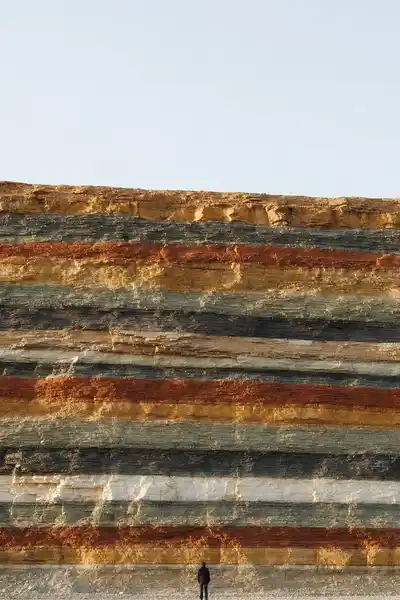
Most people drive past a road cut without seeing it. It is scenery, or it is nothing — a striped wall of rock the highway department cut through to keep the grade gentle. McPhee's premise is that these cuts are the closest thing a layperson gets to a window into the earth's interior, and that a geologist standing in front of one can read it the way the rest of us read a page. The book grows out of that simple, almost naive move: pull over, get out, and ask.
McPhee was not a scientist. He was a reporter with an unusual appetite for technical subjects, the kind of writer who would spend months learning the vocabulary of a trade before writing a word. Geology suited him because it is a field where the experts genuinely disagree, argue in the field, and revise their reading of a landscape mid-sentence. He chose not to narrate the science from above but to embed himself with practitioners and let their thinking show, doubts and all.

02Chapter 2 — Deep time along Interstate 80
Drive west on I-80 and you are, in effect, reading the continent's autobiography out of order. New Jersey and the eastern seaboard sit on rock shaped by the opening and closing of ancient oceans. The Appalachians, worn now to modest ridges, were once a mountain range on the scale of the Himalayas, thrown up when continents collided hundreds of millions of years ago and since then ground down by nothing more dramatic than weather and time. What looks like gentle country is the stump of something enormous.
Farther west, the flat middle of the continent hides its own history under sediment — the accumulated debris of eroded highlands, laid down layer on layer while the mountains that fed it disappeared. Then the Rockies, and in Wyoming a puzzle that geology spent decades arguing over: mountains that rose far inland, away from the usual plate boundaries, in an episode McPhee follows through David Love's lifetime of fieldwork in the state where he grew up. Love's Wyoming is both scientific subject and personal ground, and the book lets those overlap.
03Chapter 3 — The rock is a document, if you can read it
The intellectual spine of the book is the science of plate tectonics, which had only recently become geology's governing framework when McPhee began. For most of the twentieth century, the idea that continents move had been a fringe notion; by the 1960s and 1970s the evidence — seafloor spreading, magnetic stripes, earthquake patterns — had forced a wholesale reorganization of the field. McPhee arrives just as the older geologists in his book lived through that revolution, and some of them carry the memory of when the ground rules changed.
What tectonics gives the reader is a grammar for the road cuts. A layer of marine limestone hundreds of miles inland means a sea once covered the spot. A band of rock folded like a rumpled rug records a collision. A fault where one side has slid past the other records the slow grinding of plates. The geologists in the book do not just name these things; they reconstruct the vanished world that produced them — the sea, the mountains, the climate — from the material left behind. The rock is treated as testimony.
04Chapter 4 — What a continent looks like when you slow down
Step back from the road cuts and the book is really about a problem of perception. Human beings are equipped to feel time in seasons, years, at most a few generations. Geology asks us to hold spans a million times longer, and Annals of the Former World is, at bottom, an extended attempt to make that demand bearable — not by simplifying it, but by attaching it to things we can stand in front of. The gravel, the fault line, the tilted block become handles on a quantity the mind cannot otherwise grip.
McPhee never pretends the trick fully works. That is the honest core of the book. Deep time does not become intuitive; it stays foreign even to the specialists, who reach for it through calculation and long habit rather than feeling. What the book offers instead is a kind of trained humility — a way of standing in a landscape and sensing the enormity underneath it without deceiving yourself that you have truly imagined 4.6 billion years. The continent becomes legible without becoming small.
05Conclusion
By the time McPhee gathered the four decades of rock and the twenty-odd years of writing into one volume, he had done something no textbook quite manages: he had made a continent tell its own story, mile by mile, in the company of people who had spent their lives learning its language. The Pulitzer recognized a work of nonfiction, but it might as well have recognized a work of translation — from the mute record of stone into something a general reader can follow from a car window.